
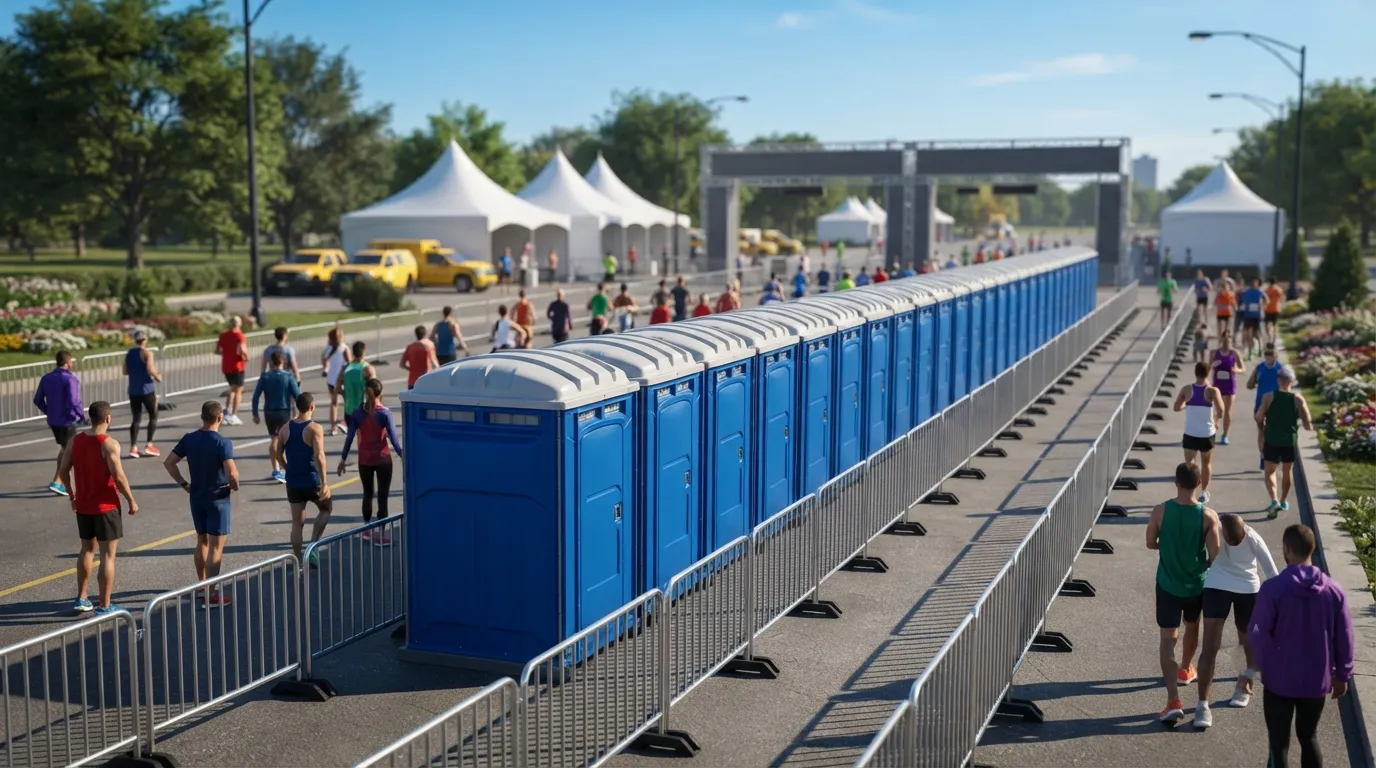
How many restrooms does a Greensboro race need?
Start with runner count, then split it across start corral, finish chute and aid stations. OSHA 1926.51(c) sets the construction-site ratio at 1 toilet for 20 workers, and race organizers commonly use that same math as a starting benchmark for spectators and volunteers, scaling up for wait-time tolerance since nobody wants a line during a 10K. A porta potty rental plan for a race usually mixes standard units for the bulk of the field with at least one ADA accessible porta potty, since ADA Standards section 213.2 requires that at least 5 percent of clustered single-user units be accessible, never fewer than one. That accessible unit needs a 60 inch turning circle per ADA Standards section 304.3.1 and a door opening at least 32 inches wide under ADA Standards section 404.2.3, so it cannot just be shoved against a fence post. If you are still working out numbers, the how many porta potties do I need guide walks through the math step by step, and our OSHA portable toilet requirements page covers the ratio in more depth. For a course that finishes near a park pavilion or a downtown block, pairing standard units with a restroom trailer rental at the finish line gives VIP runners and sponsors a nicer option without cutting into the main count.
Where should units go on a race course?
Placement drives everything else on race day. Units belong at the start corral, at the finish chute, and at any aid station past the 5K mark, spaced so a runner never sheds more than a couple minutes off pace to use one. Our porta potty placement guide covers ground clearance and access lane width, and ADA Standards section 403.5.1 sets a 36 inch minimum clear width for the accessible route leading to that unit. Surfaces need to be stable and slip resistant under ADA Standards section 302.1, which matters on grass fields and gravel lots around Greensboro more than it does on pavement. If your course runs near a construction zone or a staged event area with generators and light towers, keep restrooms clear of cable runs. Race organizers running night legs sometimes ask about how to brace a temporary power pole near a light tower or aid station, and the short answer is guy-wire anchors set in ground stakes or ballasted base plates, done by whoever supplies the temporary power pole and confirmed against the load before the tent goes up. Pair that with a light tower rental at any aid station running before sunrise. Keep the layout tight: a temporary fence rental or crowd control barrier rental around the restroom bank keeps queue lines from spilling into the course itself, which race marshals appreciate.
What does a race-day restroom package cost in Greensboro?
Race pricing depends on unit mix, duration and whether the event runs a single morning or a full weekend. A standard unit on an event-day rate runs in the range below, and a delivery fee applies on top for setup and pickup timed to your course schedule.
| unit | duration | low | typical | high |
|---|---|---|---|---|
| standard | event | 200 | 400 | 800 |
| ada | weekend | 199 | 240 | 300 |
| deluxe | week | 150 | 250 | 290 |
| delivery_fee | weekend | 125 | 200 | 540 |
Most Greensboro races run standard units on the event rate and add one or two ADA units billed on the weekend rate since race weekends often include packet pickup the day before. If your race draws a bigger crowd or runs concurrent with a festival, our festival restroom rental and concert restroom rental pages cover higher-density layouts, and the event restroom rental hub compares packages across event types. Organizers coordinating a course that crosses into Summerfield, 9.3 miles northwest of Greensboro, or loops toward Jamestown, 11.5 miles southwest, should tell us the full route so delivery trucks can plan drop points along the way rather than staging everything from one lot. For general cost comparisons outside race day, see porta potty rental cost and porta potty rental per day.
How far in advance should we book race restrooms?
Book as soon as your course map and runner estimate are final, ideally weeks out, since ADA units and restroom trailers have limited stock on peak race weekends. A request a quote submitted early lets us confirm placement before your permit walkthrough.
Do we need handwashing stations along the course?
Yes, aid stations handling food or gel packets benefit from a dedicated setup. 29 CFR 1910.141(d)(2) requires soap and towels or a hand-drying device at washing stations, not sanitizer alone. See handwashing station rental.
Can units be moved mid-race if the course changes?
Units are staged before the gun and generally stay put during the event for safety reasons. Discuss any last-minute course change with your route marshal and us together so trucks are not crossing an active course.
What happens if it rains on race day?
Units stay usable in wet weather, but ground stability matters more. Check our porta potty in winter guide for cold and wet-weather setup notes that apply to storm-affected race mornings too.
Do we need a permit for race-day restrooms in Greensboro?
Permit requirements depend on your race route and whether units sit in the public right of way, which needs confirming with the city. Our porta potty permit requirements page outlines what to check before submitting your event application.
Next step
Get a delivery date
Tell us the address, the dates and the headcount. We size the order and confirm the route.